Source writings, workshop conversations, interviews and repeated testing: the work behind the questions you see today.
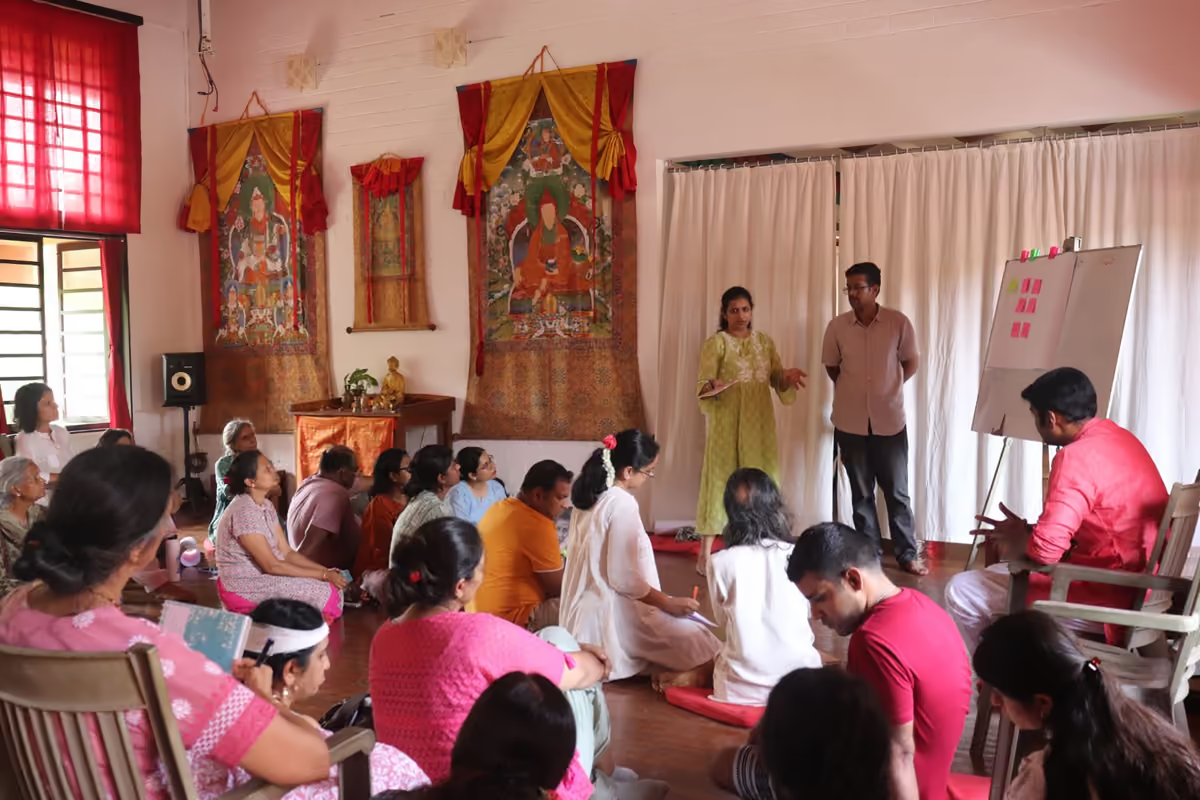
Workshop at Purnam Retreat, Auroville
How it began
It began in a Swadharma session, with a wish to see ourselves more clearly.
In a Swadharma session led by Manoj Pavithran, co-founder of Purnam, the four powers described by Sri Aurobindo and the Mother offered a way to explore how we learn, act, relate and work.
Divyanshi Chugh, also co-founder of Purnam, saw the possibility of a questionnaire. What followed was a process of source study, experimentation, workshops, participant interviews and repeated refinement.
The four powers come from the writings of Sri Aurobindo and the Mother, studied in Integral Psychology and set out in a nine-page academic paper.
02
Tested and refined
Workshops, participant interviews, a pilot study and feedback from experts in Integral Yoga Psychology shaped each revision of the questions.
03
Documented openly
The conceptual paper and the development account are both published here to read, with their sources and milestones.
Begin with the idea
Four powers. Many ways of being.
Different ways of understanding, acting, relating and creating. Tap or click a petal to explore what it means.
Select a petal to explore it
The fourfold framework
Which movement feels familiar?
You might begin by seeking understanding, meeting a challenge, bringing people together or attending to the details of a task.
The framework explores these as four powers within human nature. A leading force is a starting point for discovery; the wider inquiry is how all four can grow.
A question to carry
What comes naturally to you—and what is asking to develop?
Wisdom
The movement towards understanding: looking beneath appearances, seeking knowledge and seeing a wider perspective.
In everyday life, this may express itself through learning, reflection and the wish to understand before deciding.
Notice in your own life
When do you feel drawn to step back, study and see more clearly?
Strength
The movement towards action: courage, initiative and the will to meet difficulty and bring change.
In everyday life, this may express itself through taking responsibility, facing a challenge or standing for what matters.
Notice in your own life
What calls forth your courage and willingness to act?
Harmony
The movement towards relationship: connection, mutuality and a sensitivity to beauty and balance.
In everyday life, this may express itself through bringing people together and attending to the quality of an exchange.
Notice in your own life
Where do you naturally create connection, beauty or a sense of belonging?
Perfection
The movement towards skilful work: care, precision and the patience to give an idea a well-crafted form.
In everyday life, this may express itself through practical service, attention to detail and the satisfaction of doing something well.
Notice in your own life
What work invites your patient care and attention to detail?
Explore the four powers discussed in the paper below, then follow how they became a questionnaire.
Finding Your Native Power in the Mother’s Fourfold Force
The Four Powers of the Mother and Humanity’s Eight Soul-Types
The paper traces Wisdom, Strength, Harmony and Perfection through the writings of Sri Aurobindo and the Mother. It explores their expression in human nature, or swabhava, and develops the relationship between four soul-forces and eight practical soul-types.
Its central idea is that recognising a dominant soul-type begins a wider inquiry: how all four powers can develop and find expression in everyday life.
This account follows the work from its beginnings in a Swadharma session led by Manoj Pavithran to the development of two online profilers.
Divyanshi Chugh saw the possibility of a questionnaire that would honour all four powers equally. Source-text study, card-sorting exercises, coaching experience, participant interviews and expert review helped shape its statements and interpretation.
The account also explains why Level 2 uses ranking, and how the tool continued to develop after the initial releases.
The development account describes several kinds of work behind the questionnaire:
Returning to the source texts
Statements were drawn as closely as possible from the writings of Sri Aurobindo and the Mother, then refined through card-sorting exercises and discussion.
Comparing results with lived experience
Pooja Varshney, our clinical psychologist, led testing and interviews. The account describes several rounds involving hundreds of people for Level 1, with more than 30 individuals interviewed for version one.
Reviewing and revising statements
Feedback from participants, experts in Integral Yoga Psychology, a pilot study and a further round of testing informed revisions to the questionnaire.
Changing the scoring approach
Level 1 uses self-ratings. Level 2 uses ranking to distinguish preferences more clearly when a person identifies strongly with several soul-forces.
Divyanshi, Pooja and Manoj at a card-sorting work session, Auroville · 17 June 2022Statements drawn from the source writings, sorted and refined by hand · 7 June 2022
A tool that kept evolving
Milestones described in the development account
Begin in the workshop
Early versions were used informally in workshops, bringing the ideas into conversation with lived experience.
Give the inquiry a structure
Work began on formalising the tool.
Introduce Level 1
Level 1 offered a way to map the four soul-forces through self-ratings.
Look more closely
Level 2 introduced eight expressions of the four soul-forces, using ranking to explore preferences in greater detail.
Return, listen and refine
Level 1 statements were expanded and revised for version 2.0.
03
Built with people. Refined through practice.
The profiler developed through collaboration between facilitators, our clinical psychologist, participants and a technology team. The development account credits both close reading of the source texts and the experience of working with people over time.
La Grace workshop · June 2024
Manoj Pavithran
Co-founder, Purnam
Led the Swadharma session from which the idea emerged, and contributed to the framework and card-sorting work.
La Grace workshop · June 2024
Divyanshi Chugh
Co-founder, Purnam
Developed the questionnaire idea and the eight-type framework through source study and coaching practice; author of the accompanying paper.
Clinical psychologist and coach · Core team, Purnam
Pooja Varshney
A Registered Clinical Psychologist (RCI) and core faculty at Purnam, Pooja brings together contemporary clinical psychology and Integral Psychology. She led questionnaire testing, conducted the participant interviews and helped build the profiler tool, and now helps people see their Soul-force results more deeply and take them forward, in one-to-one coaching and workshops.
Workshop at IIM Kozhikode · November 2022Manoj and Divyanshi · La Grace Auro University · June 2024
Use in workshops and online
The profiler began within Purnam’s Swadharma programme and workshops. The development account describes its use in settings including the Transforming India Initiative and IIM Kozhikode.
Online records as of 21 October 2026, alongside the team’s offline estimate
412
Distinct email identities with a completed Level 1 or Level 2 online profile, deduplicated across both levels.
595
Completed online responses across both levels, including repeat completions.
100+
Offline workshop participants estimated by the team.
Online figures include historical imported records. Offline participants may also have completed the profiler online, so these figures are not added into a combined participant total.
Continue the inquiry
From reading to self-reflection
Level 1 explores the four soul-forces: Wisdom, Strength, Harmony and Perfection. Level 2 looks more closely at their eight expressions in practical human nature.
The result can be a starting point for observing where you feel most alive, how you work and relate, and which qualities you would like to develop further.