

Compilation · Psychic
Colours: Compilation
Passages from the works of Sri Aurobindo and the Mother on colours, each with its source.
You were of the way through. Continue reading
On this page
- Importance of Colours
- Use of Colours in Ancient Indian Art
- Significance of some the colours
- Yellow
- Blue
- Flowers in Blue
- Pink
- Significance of Pink
- Flowers in Pink
- Green
- Flowers in Green
- Purple
- Significance of Purple
- Flowers in Purple
- Gold
- Flowers in Gold
- White
- Flowers in White
- Orange
- Flowers in Orange
- Red
- Flowers in Red
- Sources
A revel of colour and of ecstasy,1
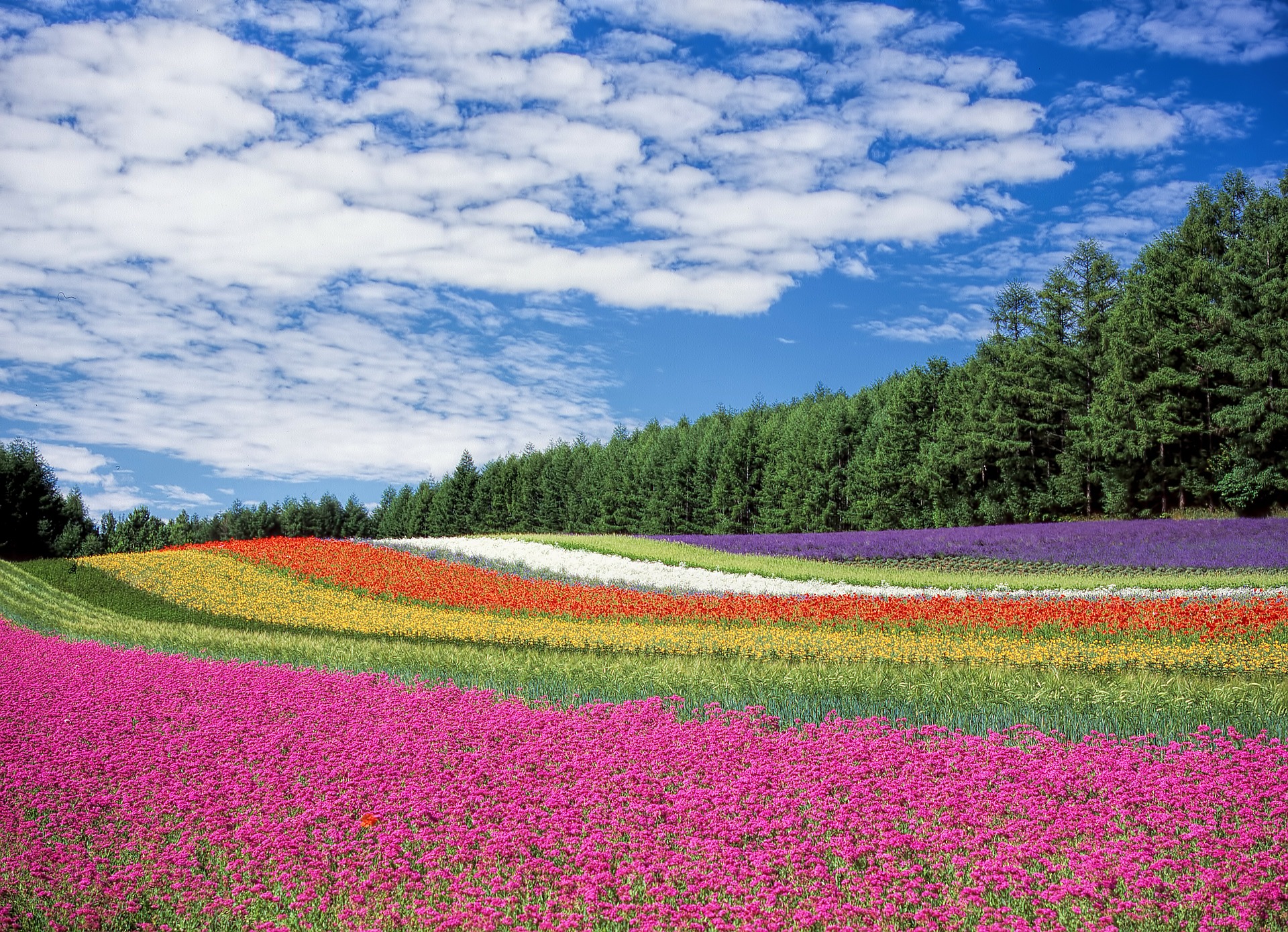
Importance of Colours
It is quite well known that each colour has its significance, but the meanings attached to the various colours by different interpreters vary and are often conflicting. There does not seem to exist any universally accepted classification of these significances. This is because these colours are considered from a mental standpoint, or at least because the vision is influenced by the mind of the interpreter. But if one rises above the mind to the truly occult regions beyond, the real meaning of each colour is the same for all those who can read it directly. This is true not only in this particular case but for all occult and spiritual experience. There is a remarkable similarity in the experiences of mystics of all times and places.2
The education in colours is tremendous—in both detail and complexity. If you learn how to distinguish all the colours, to know to what family of colours each belongs, what kind of harmony it can bring about—you can know, it is the same thing. You can keep the memory of the colour as you keep the memory of the form. You want to match all your things… for example, you want to match two things: you want to match a cloak with a skirt or a… well, anything at all… or maybe one kind of cloth with another. Usually you are obliged to take one and then go and compare it with the others; and finally, after many trials, if you are not too clumsy, you finish by finding it. But if you have the training in colour, you look at the colour once and go straight to what matches with it, without any hesitation, because you remember exactly the nature of this colour and go to a colour that can harmonise with it.
Take just the relations of colours—there are many other things, there is the relation of forms which is more complicated still—but the relation of colours: you take a colour and put it beside another; and it happen that these groups of colours don’t go together. Then, if you have no training, sometimes you are not even aware of it. Sometimes you say, “Oh, it is not very pretty.” But you don’t know why, you are not at all conscious of the reason. But when you are trained, when you have trained your eye, first of all you never make a mistake like this, you never bring together two things which don’t go together; and if by chance, on someone else you see things which are not at all made to go together, you don’t have that vague kind of feeling which says, “Oh, it is not pretty, oh, it is not good”, a kind of vague thing… you don’t know why it isn’t pretty, it isn’t pleasant. And it is precisely because one colour belongs to one class and the other to another class of colours, and if you bring together these two different classes without some intermediary colours to harmonise them, they shriek. You can immediately find the remedy because you know where the fault lies.
If we compare the essential truth to a sphere of immaculate, dazzling white light, we can say that in the mental medium, in the mental atmosphere, this integral white light is transformed into thousands and thousands of shades, each of which has its own distinct colour, because they are all separated from one another. The medium distorts the white light and makes it appear as innumerable different colours: red, green, yellow, blue, etc., which are sometimes very discordant. And the mind seizes, not a little fragment of the white light of the white sphere, but a larger or smaller number of little lights of various colours, with which it cannot even reconstitute the white light. Therefore it cannot reach the truth. It does not possess fragments of truth, but a truth that is broken up. It is a state of decomposition.
In interpreting these [visions] phenomena you must remember that all depends on the order of things which the colours indicate in any particular case. There is an order of significances in which they indicate various psychological dynamisms, e.g., faith, love, protection, etc. There is another order of significances in which they indicate the aura or the activity of divine beings, Krishna, Mahakali, Radha or else of other superhuman beings; there is another in which they indicate the aura around objects or living persons—and that does not exhaust the list of possibilities. A certain knowledge, experiences, growing intuition are necessary to perceive in each case the true significance. Observation and exact description are also very necessary; for sometimes people say, for instance, yellow when they mean gold or vice versa; there are besides different possible meanings for different shades of the same colour. Again, if you see colour near or round a person or by looking at him or her, it does not necessarily indicate that person’s aura; it may be something else near him or around him. In some cases it may have nothing to do with the person or object you look at, which may serve merely the purpose of a background or a point of concentration—as when you see colours on a wall or by looking at a bright object.
There are no separate colours of the beings. There is a characteristic colour of mind, yellow, of the psychic, pink or pale rose, of the vital, purple; but these are colours corresponding to the forces of mind, psychic, vital—they are not the colours of the beings. Also other colours can play, e.g. in the vital, green and deep red as well as purple and there are other colours for the hostile vital forces.3
Use of Colours in Ancient Indian Art
There is in all the art an inspired harmony of conception, method and expression. Colour too is used as a means for the spiritual and psychic intention…4
Indian culture was able to arrive at a well developed and an understanding aesthetic use of colour and line from very early times and, allowing for the successive fluctuations, periods of decline and fresh outbursts of originality and vigour, which the collective human mind undergoes in all countries, used this form of self-expression very persistently through the long centuries of its growth and greatness. And especially it is apparent now that there was a persistent tradition, a fundamental spirit and turn of the aesthetic sense native to the mind of India which links even the latest Rajput art to the earliest surviving work still preserved at its highest summit of achievement in the rock-cut retreats of Ajanta.
The painter on the contrary lavishes his soul in colour and there is a liquidity in the form, a fluent grace of subtlety in the line he uses which imposes on him a more mobile and emotional way of self-expression. The more he gives us of the colour and changing form and emotion of the life of the soul, the more his work glows with beauty, masters the inner aesthetic sense and opens it to the thing his art better gives us than any other, the delight of the motion of the self out into a spiritually sensuous joy of beautiful shapes and the coloured radiances of existence.
He [Indian artist] begins from within, sees in his soul the thing he wishes to express or interpret and tries to discover the right line, colour and design of his intuition which, when it appears on the physical ground, is not a just and reminding reproduction of the line, colour and design of physical nature, but much rather what seems to us a psychical transmutation of the natural figure. In reality the shapes he paints are the forms of things as he has seen them in the psychical plane of experience: these are the soul-figures of which physical things are a gross representation and their purity and subtlety reveals at once what the physical masks by the thickness of its casings. The lines and colours sought here are the psychic lines and the psychic hues proper to the vision which the artist has gone into himself to discover.5
Significance of some the colours
I never heard of two lotuses in the heart centre; but it is the seat of two powers, in front the higher vital or emotional being, behind and concealed the soul or psychic being. The colours of the lotuses and the numbers of petals are respectively, from bottom to top:—(1) the Muladhara or physical consciousness centre, four petals, red; (2) the abdominal centre, six petals, deeper purple red; (3) the navel centre, ten petals, violet; (4) the heart centre, twelve petals, golden pink; (5) the throat centre, sixteen petals, grey; (6) the forehead centre between the eyebrows, two petals, white; (7) the thousand-petalled lotus above the head, blue with gold light around. The functions are, according to our Yoga,—(1) commanding the physical consciousness and the subconscient; (2) commanding the small vital movements, the little greeds, lusts, desires, the small sense-movements; (3) commanding the larger life-forces and the passions and larger desire-movements; (4) commanding the higher emotional being with the psychic deep behind it; (5) commanding expression and all externalisation of the mind movements and mental forces; (6) commanding thought, will, vision; (7) commanding the higher thinking mind and the illumined mind and opening upwards to the intuition and overmind.6
Yellow
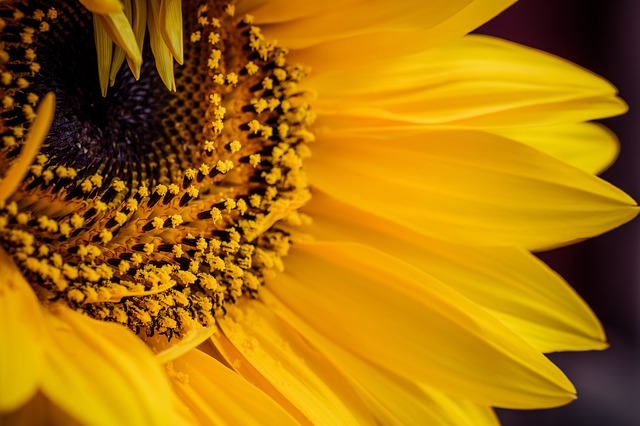
Significance of Yellow
…yellow is the most glorious colour of all. It is the golden colour of Light—the Light which comes from the Source and Origin of all things and which, with its helping hand, will lead evolving humanity back to its divine Origin.7
Q. Can one tell when the colour yellow indicates the mind and when it indicates light?
A. Greenish yellow is mental.
Orange yellow is the symbol of light.
There is a characteristic colour of mind,yellow…
Yellow is the colour of the light of the thinking mind… The shades indicate different intensities of mental light.
A certain kind of y