

From Livelihood to Worship: How Our Relationship with Work Evolves

What changes in our work as we grow in consciousness? A reflection on the pathway of Karma Yoga, based on Divyanshi Chugh’s talk.
Consider two people at work. One sweeps the floor with attention, care and love. Another holds a prestigious position but performs their duties mechanically, with little sincerity or involvement.
Whose work carries a deeper spiritual value?
We need to start looking beyond the hierarchies through which we usually judge an occupation. From a yogic perspective, the quality of consciousness we bring to an action matters more than its salary, status or visibility.
This is the core of Karma Yoga: our daily work can become a field of spiritual practice. As our consciousness grows, the meaning of work itself begins to change.
In this article 5 sections
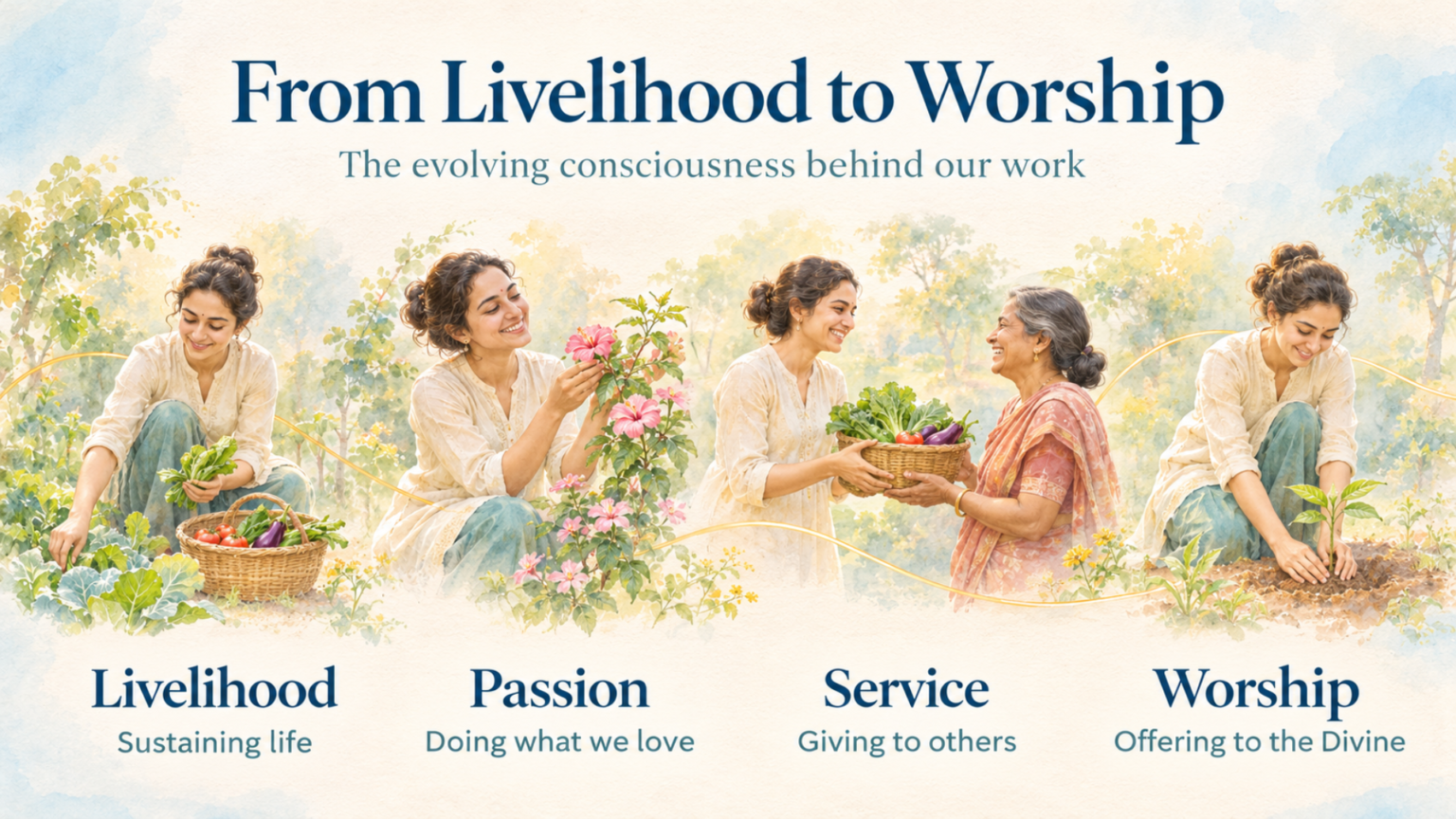
Work as livelihood
For most of us, work begins with necessity. We earn to sustain ourselves, support our families and create some security for the future. These responsibilities are the primary reason most people work, and why it is so intimately tied to livelihood.
Yet money can also become the measure through which we assess both work and people. We may unconsciously equate higher pay with greater worth, overlooking the care and sincerity present in less recognised forms of labour.
We need to become conscious of this subtle relationship with money. Even when we find meaningful work or feel committed to service, anxiety about security, attachment to income and the desire for recognition may continue to influence our choices. Seeing these movements honestly is the first step.
Work as passion
A further opening comes when we seek something more than a livelihood. We want to use our gifts, express ourselves and feel alive in what we do. Work becomes a source of joy.
This is a significant movement. But the familiar advice to “do what you love” carries an important question: what happens when the work includes something we do not love?
Every meaningful undertaking involves tasks that feel inconvenient or uninteresting. If our willingness to work depends entirely on enjoyment, our likes and dislikes will continue to govern us.
Karma Yoga asks for equanimity: the capacity to bring a steady, sincere attention to the work before us. An ordinary task, done wholeheartedly, can reveal how much of our energy we withhold simply because we are focusing on what we want.
Work as service
Our relationship with work widens when we begin to ask how our capacities can serve others.
A teacher finds fulfilment in a child’s understanding. A doctor offers skill and care to someone in pain. A person tending the land works with a sense of responsibility towards the earth and the life it sustains.
Here, the center of our motivation begins to shift. Personal satisfaction makes room for contribution. We experience the joy of giving ourselves to something larger than our individual needs.
Work becomes an expression of care for humanity, community and nature. This growing capacity for self-giving prepares the ground for a deeper offering.
Work as worship
There is a further movement in which work becomes sadhana—a conscious spiritual practice—and an offering to the Divine.
This asks for a profound change in our orientation. In whatever circumstances we find ourselves, we seek to bring forward the best of our being: clarity in thought, strength in action, love in relationship, and care and beauty in physical execution.
Serving the Divine includes our concern for people and the world. That concern is held within a wider consciousness, and our work becomes a means of expressing it.
The practice reaches into small moments. Can we listen fully when someone interrupts us? Can we complete an unnoticed task with care? Can we recognise impatience or the need for appreciation, and return to the spirit of offering?
Such moments give substance to the aspiration that work may become worship.
The inner fire and the outer work
Sustained self-giving can bring us into closer contact with our inner truth. The aspiration within us grows clearer, and our work in the world may gradually take shape around it.
Discovering that calling needs patience and sincerity. We begin by offering ourselves more fully to the work already in our hands.
These stages can serve as a mirror. In a single day, we may work from financial concern, enthusiasm, generosity and devotion. Each movement gives us something to observe and understand.
For our own practice, we might choose one ordinary task this week and give it our full attention. Notice any resistance, then gently renew the offering. The next task before us is already an opportunity to practice.
Did this help you?

Share a reflection