

Learning as a Field of Consciousness: Insights from the Purnam Ecosystem
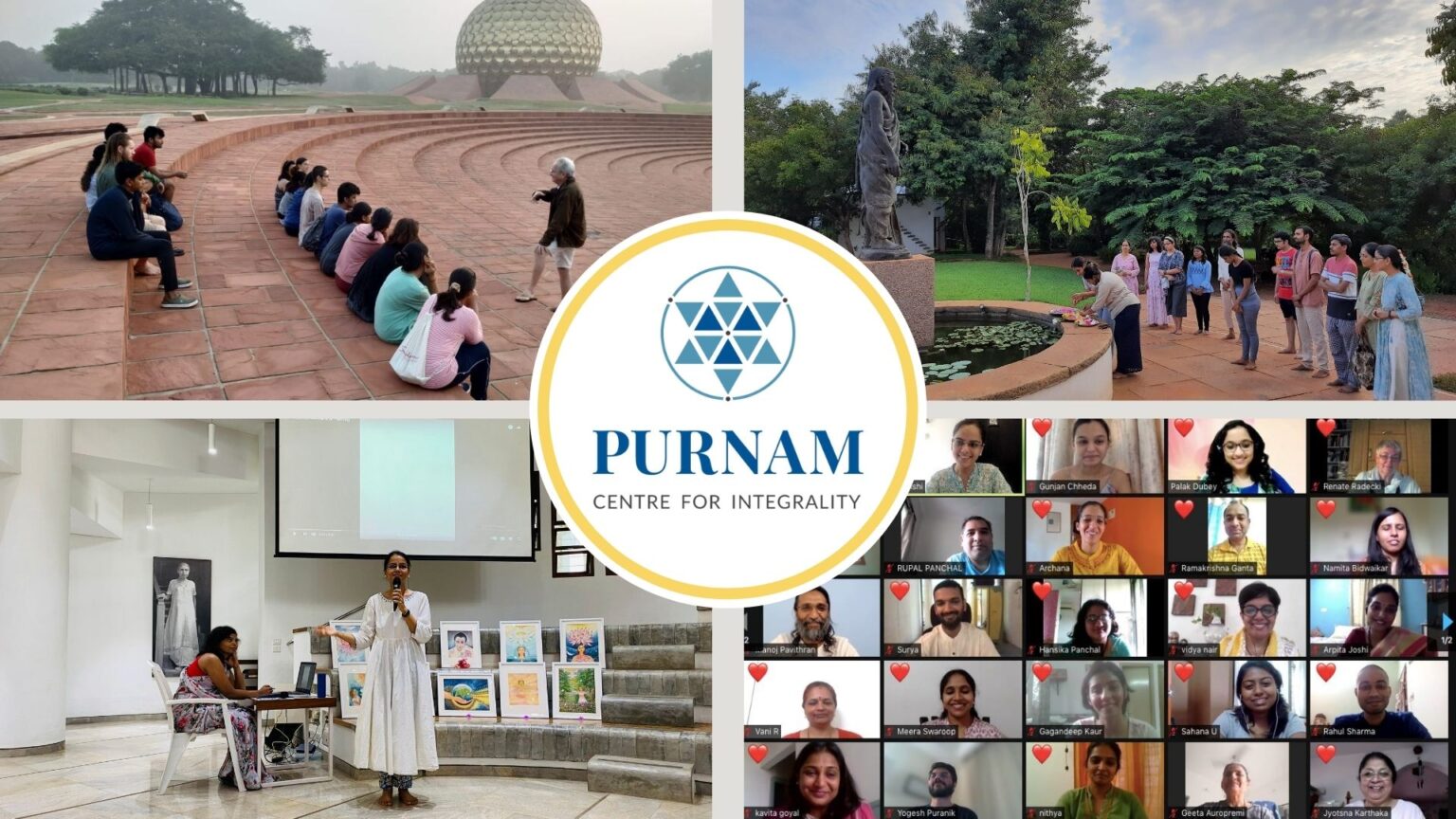
Based on an interview with Divyanshi Chugh, founder and CEO of Purnam Centre for Integrality, by researcher Sudipta
“I used to take very hefty notes,” says Divyanshi Chugh, remembering her first year studying Sri Aurobindo and the Mother. “But I understood that what they passed was a certain consciousness, and it wasn’t what they spoke so much.” Her teachers, she realised, were instruments of the Mother, holding a living field in which each student could grow in their own way. “The creation of that force field is called education.”
What transforms a seeker is not the volume of information taken in but the consciousness one comes into contact with. It has become the foundation of Purnam, shaping everything from how a course unfolds to how a team is formed.
In this article 6 sections
Change happens where you live
Purnam’s work moved online through a spontaneous impetus. The strength of this approach soon became clear. Most seekers know the pattern: a retreat or a stay at an ashram lifts us into a different state, but within weeks of returning to family, work and routine, much of it seems to dissolve. Divyanshi Chugh says, “online is about helping people make changes and breakthroughs while they stay in their own contexts,” because that, however difficult, is “where change eventually needs to percolate.”
Online, for Purnam, has never meant casual or less rigorous. The team’s guide to holding a single Zoom meeting runs to 25 pages, and its retreats in Auroville are planned to the minute, every member of the team moving like dancers in a choreography. Community keeps the practice alive between these moments. Purnam Labs began simply, when participants wanted to keep journaling after a course ended and chose to sit and journal together. It has since grown into communities of practice across dozens of themes, each born from a genuine need of seekers. Retreats in Auroville then come as a deepening of what has already taken root at home, rather than as a starting point.
The soul first, then the skill
“We get people who are connected with their souls to develop skills, and not the people who have skills to develop the soul.” Purnam does not hire by CV. Its team is drawn from seekers who first went through its programmes or volunteered with it, and who then learned marketing, technology and even accounting as part of their karma yoga, often building their own systems along the way. This shapes the whole culture of the team. Positions of responsibility are entrusted to those who wish to serve, not to those who seek power.
Teaching that grows out of living
Behind every Purnam programme lies a simple aspiration: what is taught should come from what is lived. Scholarship alone is not what qualifies a person to guide others. Without a lived connection, teaching easily slips into preaching.
No one embodies this perfectly. It is held instead as a direction and a standard of sincerity, and that is what the learner receives: not just ideas, but people who are themselves walking the path they speak about. It means growth at Purnam happens slowly. This is a conscious choice: depth over speed.
Real progress cannot be scored
“Assessment is 1% of education,” Divyanshi Chugh says. As a person becomes more sincere and self-aware, they begin to see themselves more truly, flaws included, so any score of their inner state would become “more realistic and more pure,” not higher. The very progress that matters most is the one a test cannot capture.
Purnam therefore has no exams. Growth is supported, and carefully tracked, through accountability, community and projects, so that learners can turn inward instead of performing for a mark or for approval. Being financially self-sustaining also keeps Purnam outside the accreditation system, which leaves its curriculum free to serve one purpose alone: the learner’s evolution.
All Life is Yoga
Purnam begins from life as it is, following Sri Aurobindo’s principle of moving from the near to the far. For one person the starting point may be decluttering a home, for another a wish to work with money more consciously, for another the search for a true calling, and each of these can open into something deeper. What matters is not age or background but sincerity. Some of the most beautiful progress, Divyanshi Chugh notes, comes from people such as homemakers, who have never needed to be “somebody” in the world and whose humility allows them to surrender and serve wholeheartedly.
Built to outlast its founders
Purnam’s curriculum, culture and systems took shape under its founders. From the start, part of that work has been to make sure Purnam does not depend on any one person showing up. “The institution has to outlast me,” Divyanshi says.
In practice, this means patiently forming each team member, documenting systems in detail, and designing programmes that can be carried with depth and integrity by many hands. What Purnam hopes to pass on is what her own teachers once passed on to her in Pondicherry: not a personality, but a consciousness, carried forward by everyone it touches.
Did this help you?

Share a reflection